
Finding a detox center near you means locating a medically supervised facility where licensed professionals manage your withdrawal safely while preparing you for the next phase of treatment. Medical detox isn’t just about stopping substance use — it’s the foundation on which lasting recovery is built.
Most people searching “detox near me” at two in the morning aren’t doing academic research. They’re scared. They’re exhausted. They’re watching someone they love deteriorate, or they’re finally ready to stop the cycle themselves. That moment of searching — that’s the moment that matters. And what you find in those first few minutes can change everything.
Turning Point of Tampa has been providing medically supervised detox and addiction treatment from our Tampa campus since 1987. Our facility offers the complete continuum of care — from withdrawal management through residential, day treatment, intensive outpatient, and long-term aftercare — all on a single campus. Our clinical team includes board-certified physicians and addiction specialists who have guided thousands of individuals through detox safely. We don’t just get you through withdrawal. We get you ready for recovery.
What Medical Detox Actually Is

Medical detox is the process of clearing substances from the body under clinical supervision. But let’s be real — it’s much more than that. It’s the phase where withdrawal symptoms are managed, safety is monitored, and the groundwork for real treatment begins.
Here’s the thing: detox alone is not treatment. Think of it as the doorway — essential, but not the destination. Without proper clinical support after detox, relapse rates are high. That’s why entering a facility that treats detox as the first step in a full continuum — rather than an isolated service — is so important.
Medical detox typically involves:
- Assessment and intake — Clinicians evaluate your physical health, substance use history, mental health, and medical needs
- 24/7 monitoring — Vital signs, withdrawal symptoms, and comfort are tracked around the clock
- Medication management — Where appropriate, FDA-approved medications can reduce withdrawal severity and lower the risk of life-threatening complications
- Stabilization — Physical and psychological stabilization before transitioning to the next level of care
- Treatment planning — Building a personalized roadmap for what comes after detox
Some substances — alcohol, benzodiazepines, and opioids among them — carry significant medical risks during withdrawal. Attempting to detox from these substances without medical supervision can be dangerous, or even life-threatening. This isn’t a scare tactic. It’s simply the clinical reality, and it’s exactly why professional medical detox exists.
How Long Does Detox Take?

One of the first questions people ask is: how many days will this take? The honest answer is that it varies — and anyone who gives you a single number without asking about your situation isn’t being straight with you.
Most medically supervised detox programs last between 5 and 10 days, though the timeline depends on:
| Factor | How It Affects Duration |
|---|---|
| Substance type | Alcohol and benzodiazepine withdrawal often takes longer than stimulant withdrawal |
| Duration of use | Longer, heavier use typically means a longer stabilization period |
| Polydrug use | Multiple substances complicate the withdrawal timeline |
| Medical history | Pre-existing conditions can extend the monitoring period |
| Individual metabolism | Body chemistry affects how quickly substances clear |
The takeaway? Your detox timeline is yours. Rushing it compromises safety. A good facility won’t push you out before you’re ready, and ours doesn’t.
Client Spotlight
Patricia had been drinking heavily for nearly a decade — wine in the evenings that turned into wine all day, until she couldn’t get through a morning without it. Her daughter found Turning Point of Tampa after searching for detox programs that could handle alcohol withdrawal medically. What she didn’t expect was how thorough the intake process would be — staff asked questions she hadn’t been asked before, about anxiety, sleep, trauma. Patricia spent seven days in detox, monitored closely after a difficult third day. When she transitioned to residential care on the same campus, she already recognized the faces around her. That familiarity made all the difference in the early days.
What to Look For in a Detox Center
Not all detox facilities are equal. Knowing what to look for — and what to ask — helps you make a decision you feel confident about.
Ask about medical oversight. Does the facility have licensed physicians available around the clock? Can they manage serious withdrawal complications? This is non-negotiable for alcohol and benzodiazepine detox.
Ask what happens after detox. If a facility can’t tell you clearly what step follows, that’s a problem. Detox without a transition plan is incomplete care.
Ask about dual diagnosis. Many people entering detox also struggle with depression, anxiety, PTSD, or other mental health conditions. A facility that only addresses the substance side of the equation is missing half the picture.
Here are the key questions to ask any detox facility:
- Is this a ASAM Level 3.7 withdrawal management program?
- Do you have 24/7 physician and nursing coverage?
- Do you treat co-occurring mental health conditions?
- What happens at the end of detox — where does care continue?
- Are you in-network with my insurance?
- Can family members stay in contact during detox?
Understanding the Levels of Care After Detox
Detox is the first level on the continuum. What you step into next determines how durable your recovery becomes. At Turning Point of Tampa, every level of care is available on one campus — and that’s not just convenient. It’s clinically meaningful.
Consistent relationships with the same clinical team, the same peer community, and the same supportive environment remove the disruption that often triggers relapse during transitions.
| Level of Care | What It Involves | Who It’s For |
|---|---|---|
| Medical Detox | 24/7 medical supervision, withdrawal management | Those with physical dependence on substances |
| Residential Treatment | Live-in structured programming, daily therapy | Individuals needing intensive support post-detox |
| Partial Hospitalization (PHP) | Up to 7 days/week, clinic-based intensive care | Step-down from residential or crisis stabilization |
| Intensive Outpatient (IOP) | Structured therapy several days per week | Those with stable living situations building skills |
| Virtual IOP | Same clinical content, delivered online | Those with geographic or scheduling barriers |
| Recovery Residences | Sober living with peer support | Individuals needing structured housing during outpatient |
The single-campus advantage means you don’t have to start over. Your care team follows your progress. Your peers walk alongside you. Every transition is planned, not scrambled.
How Much Does Detox Cost?
Cost is a real concern — and you deserve a straight answer. The cost of medical detox in the U.S. ranges widely: inpatient medical detox typically runs between $5,000 and $25,000 for a 5- to 10-day stay, depending on the facility, level of care, and geographic location.
Here’s what most people don’t realize: your health insurance may cover a significant portion — or all — of it. Turning Point of Tampa is in-network with most major insurance providers, and our admissions team works with you to verify your benefits before you commit to anything.
Don’t let cost stop you from making that call. Let us figure out the numbers together.
Client Spotlight
Marcus had tried to quit opioids on his own four times. Each time, the withdrawal sent him back. When his sister finally reached out to Turning Point of Tampa, she wasn’t sure what to expect — she’d assumed cost would be the barrier. The admissions team walked her through his insurance coverage the same afternoon. Marcus entered detox within 48 hours, with a clear plan already mapped out for residential care immediately after. Knowing there was a “what’s next” already in place was the first thing that made him believe this time could be different.
Are There Free or Low-Cost Detox Options?
Some faith-based organizations and publicly funded programs offer low-cost or sliding-scale detox services. State-funded treatment programs exist throughout Florida and can be accessed through SAMHSA’s helpline or the Florida Department of Children and Families. These options exist, and they serve an important role.
That said, if you have insurance — including Medicaid or TRICARE — you may qualify for more comprehensive medical detox without significant out-of-pocket cost. We’re a VA Community Care Network preferred provider and accept TRICARE for eligible veterans and active duty service members. Our admissions team can help you understand your options quickly.
What Our Approach to Detox Looks Like
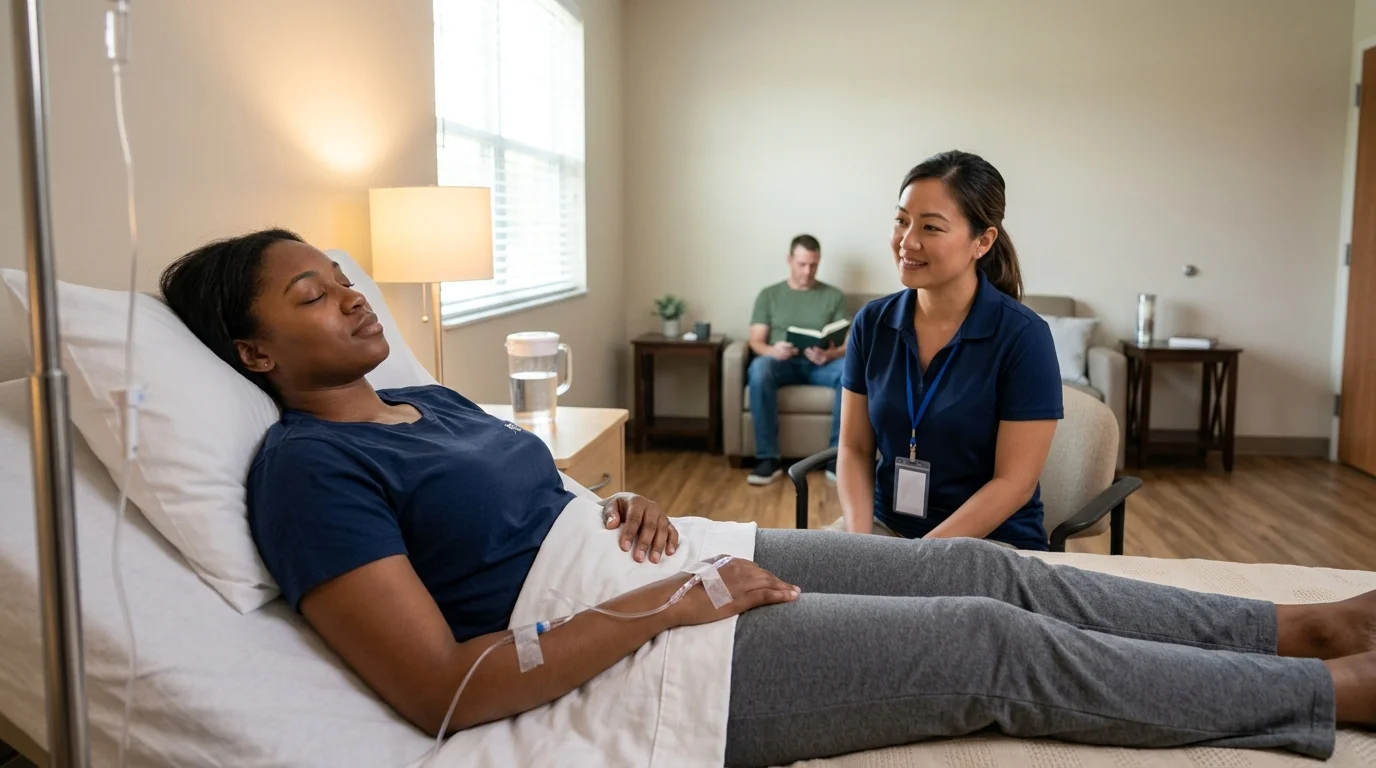
What sets our approach apart comes down to one belief: detox is the beginning, not the finish line.
We’ve been treating addiction on our Tampa campus for nearly four decades, and we’ve learned that what happens in the first 72 hours of withdrawal — and what happens immediately after — shapes the entire recovery trajectory. That’s why our detox program is ASAM Level 3.7 certified, why our clinical team is available around the clock, and why every person who completes detox here has a clear path forward before they ever leave that first level of care.
Our treatment addresses addiction, co-occurring mental health conditions, and — for those who need it — eating disorders that frequently accompany substance use. We don’t compartmentalize. We treat the whole person, because that’s the only approach that produces lasting results.
Structure is at the center of our philosophy. Recovery through responsibility isn’t a slogan — it’s how we program each day, from the moment someone enters detox through their transition to residential, PHP, IOP, and beyond. Free weekly aftercare groups are available for life. Not for 90 days. For as long as you need them.
Supporting Articles
- Detox Centers in Tampa — A focused look at medical detox facilities in the Tampa area and what to consider when choosing one close to home.
- What Helps with Alcohol Withdrawal — Explains the clinical and supportive strategies used to manage alcohol withdrawal symptoms safely during medically supervised detox.
- The Right Way to Detox From Alcohol — Covers why attempting alcohol detox at home carries serious risks and what a supervised medical program provides instead.
- Everything You Need to Know About Opioid Detox — A thorough resource on what to expect during opioid withdrawal, how medications are used, and what comes after.
- Inpatient Vs. Outpatient Rehab in Tampa — Helps readers understand the difference between residential and outpatient options so they can make an informed decision about level of care.
Frequently Asked Questions
How Many Days Do You Stay in Detox?
Most medically supervised detox programs last between 5 and 10 days, though the exact length depends on the substance involved, the severity of dependence, your overall health, and whether multiple substances are present. Some individuals stabilize in 3 to 5 days; others need up to two weeks. Your clinical team determines the appropriate timeline based on your specific needs.
How Much Does It Cost to Get a Detox?
Inpatient medical detox in the U.S. typically costs between $5,000 and $25,000 for a standard stay. The actual cost depends on the level of medical care required, the length of stay, and your insurance coverage. Turning Point of Tampa is in-network with most major insurance providers — our admissions team can verify your benefits quickly and help you understand your out-of-pocket responsibility before you begin.
Are There Free Detox Centers?
Some publicly funded and faith-based programs offer low-cost or no-cost detox services on a sliding scale. In Florida, state-funded options can be accessed through the Florida Department of Children and Families or SAMHSA’s national helpline. If you have insurance — including Medicaid, Medicare, or TRICARE — you may qualify for comprehensive medical detox with little or no out-of-pocket cost.
What Services Does Turning Point of Tampa Offer?
Turning Point of Tampa offers the full continuum of addiction and behavioral health care: medical detox (ASAM Level 3.7), residential treatment (ASAM Level 3.5), partial hospitalization (PHP), intensive outpatient (IOP), virtual IOP, and recovery residences. We also specialize in eating disorder treatment and dual diagnosis care for co-occurring mental health conditions.
Can I Just Detox at Home?
Attempting detox at home — especially from alcohol, benzodiazepines, or opioids — carries serious medical risks including seizures, severe dehydration, and in some cases, life-threatening complications. Medically supervised detox isn’t about lack of willpower. It’s about managing a genuine physiological process safely, with clinical support available the moment you need it.
What’s the Fastest Way to Detox Your Body?
There’s no medically sound shortcut to detox. “Rapid detox” procedures that promise to accelerate the process under sedation carry significant safety risks and don’t address the underlying addiction. The most effective approach is medically supervised detox at an appropriate pace — managed by licensed clinicians who can address withdrawal symptoms as they emerge and prepare you for treatment.
What Happens After Detox Is Complete?
Detox is the first step, not the solution. After stabilization, most individuals transition into residential treatment, partial hospitalization, or an intensive outpatient program. At Turning Point of Tampa, that transition happens on the same campus with the same clinical team — no disruption, no starting over. Your treatment plan is built before detox ends so you move forward with clarity and support already in place.